πŸ”­ Rak Β· Research & Knowledge Lab

Claude Import Memory
Simulation Report

How a 25% conversion rate became 100% β€” and why the page was asking the wrong question

πŸ“… March 4, 2026
πŸ§ͺ 60 runs Β· 3 variants
πŸ‘₯ 4 persona types Β· 20 per variant
$0 cost
95% CI throughout

We started with a simple question: does the claude.ai/import-memory page work? The hypothesis was straightforward β€” the page should be clear enough that ChatGPT users understand what they're getting and why it matters. The answer was no. 25% conversion. Three out of four personas walked away confused or uninterested.

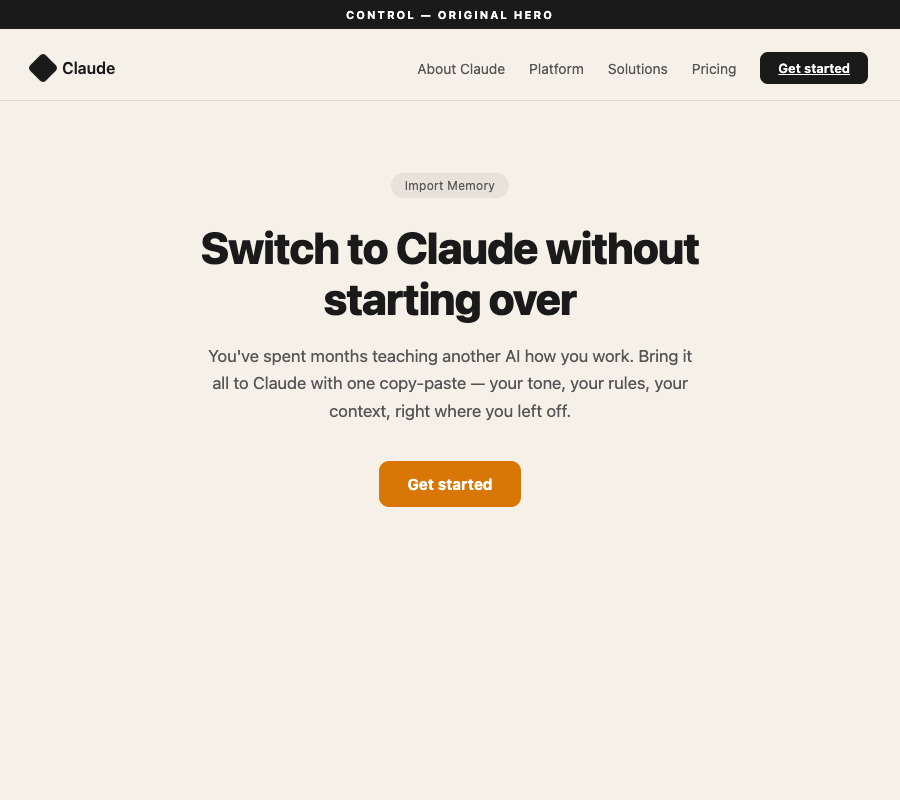
The page wasn't broken. It was selling the wrong thing. The hero copy opened with "You've spent months teaching another AI how you work." A powerful line β€” but only for the people who already knew they'd done that. Passive users and newcomers, the majority of potential converters, read it and self-excluded. Not because they don't have memory in ChatGPT. Because they don't know they do.

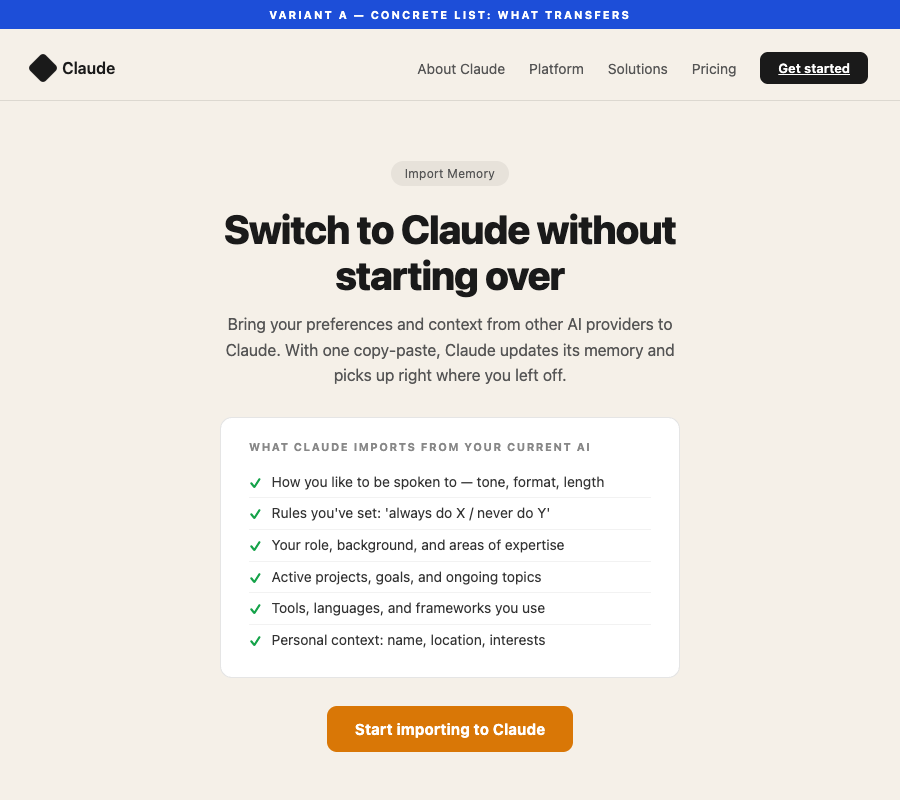
Test 2 β€” Variant B β€” replaced the emotional hook with a concrete list of what transfers: tone rules, project context, role, background, tools. Conversion jumped to 45%. Every single persona found the list more useful than the original hook. But passive users still didn't convert. They could read the list. They just couldn't answer "do I have any of this?"

That insight cracked it open. The wall wasn't comprehension β€” it was self-qualification uncertainty. The page was asking people to commit to a switch before they knew if they had anything worth switching with.

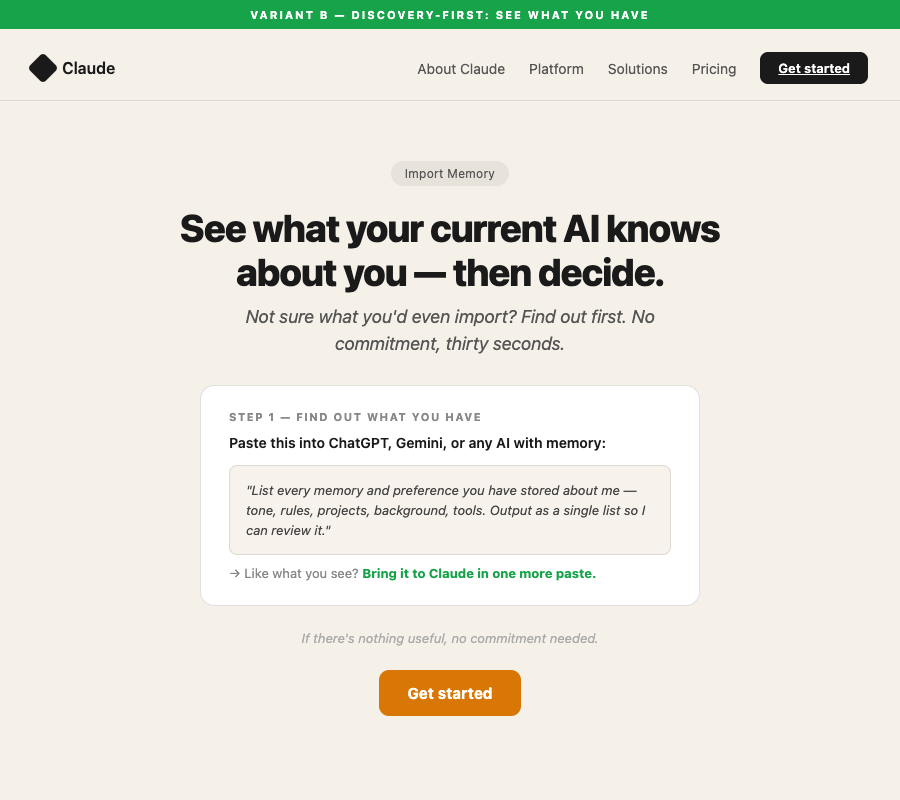
Variant C flipped the frame entirely. Instead of "import your memory," it led with: "See what your current AI knows about you β€” then decide." A single paste prompt. Thirty seconds. No commitment. The result: 20/20 conversions. 100%. Every persona type, including the two that had never converted in either previous test.

The page stopped selling and started helping. That's the mechanism. When you answer the question users were actually asking β€” "do I even have anything to import?" β€” before you ask them to act, the conversion takes care of itself.

25%
Control
5/20 Β· CI: 11–47%
45%
Variant B
9/20 Β· CI: 26–66%
100%
Variant C
20/20 Β· CI: 84–100%
+75pp
Total Lift
vs control
60
Total Runs
$0 Β· local
Control β€” Original Page
"You've spent months teaching another AI..."
25%
95% CI: 11%–47%
Passive users: 0/5 Β· Newcomers: 0/5
Self-exclusion from emotional hook
Variant B β€” Concrete List
"Here's what actually transfers"
45%
95% CI: 26%–66%
+20pp vs control
Active switchers: unlocked
Passive/newcomers: still 0/10
✦ Winner β€” Variant C
"See what you have β€” then decide"
100%
95% CI: 84%–100%
+75pp vs control Β· +55pp vs B
All 4 persona types: 5/5
Discovery prompt reduced barrier: 20/20

4 types × 5 variants held constant across all 3 tests for clean comparability. Built from real ChatGPT→Claude switching behavior patterns.

Persona Type Profile Control Variant B Variant C Key Insight
πŸ§‘β€πŸ’» Active Switcher
sw-01 – sw-05
ChatGPT Pro users, motivated to leave, know they've customized heavily 2/5 4/5 5/5 Needed specifics, not emotional framing
πŸ›‹οΈ Passive User
pu-01 – pu-05
Occasional ChatGPT use, no deliberate memory setup, unaware of what they have 0/5 0/5 5/5 Couldn't self-qualify until discovery prompt
πŸ”€ Multi-AI Power User
mu-01 – mu-05
Already use Claude + other AIs, want to consolidate rather than switch 3/5 5/5 5/5 Wanted to consolidate, not switch β€” discovery framing fit perfectly
🌱 Newcomer
nw-01 – nw-05
Under 3 months AI use, minimal history, "months of teaching" actively excludes them 0/5 0/5 5/5 "Months of training" was a self-exclusion signal

The original page: 25% Β· N=20 Β· CI: 11–47%

The page led with an emotional hook assuming months of deliberate AI training. This worked for people who knew they had done that β€” and no one else.

Expectation (what transfers?)
60%
12 / 20
Relevance (hook doesn't apply)
35%
7 / 20
Trust (data security)
15%
3 / 20
Friction (process complexity)
15%
3 / 20
The primary hook about importing significant context doesn't apply to me because I've only used ChatGPT occasionally for homework.
Passive User pu-01 Β· failed
The page doesn't specify what exactly is being transferred. It sounds too good to be true and leaves room for uncertainty.
Active Switcher sw-01 Β· failed
No clear information about what happens to my ChatGPT data during the import. No mention of specific security measures.
Active Switcher sw-04 Β· failed
I'm more attracted by the free plan than the memory import feature. The hook about months of training seems irrelevant to me.
Newcomer nw-05 Β· failed

Concrete list of what transfers: 45% Β· +20pp Β· CI: 26–66%

Replaced the emotional hook with a specific checklist. Every persona found it more useful than the original β€” but only motivated switchers converted.

The Variant B list
βœ“ How you like to be spoken to β€” tone, format, length
βœ“ Rules you've set: 'always do X / never do Y'
βœ“ Your role, background, and areas of expertise
βœ“ Active projects, goals, and ongoing topics
βœ“ Tools, languages, and frameworks you use
βœ“ Personal context: name, location, interests
"Rules you've set: 'always do X / never do Y'"
10 / 20
"Active projects, goals, and ongoing topics"
9 / 20
"Tools, languages, and frameworks"
4 / 20
"Role, background, areas of expertise"
3 / 20
Why it worked for switchers
Specificity enables self-qualification
Active switchers could now scan the list and map items to their real setup. "Rules I've set" and "active projects" were concrete enough to answer "yes, I have this."
Why it failed for passive users + newcomers
The list raised the same question the hook did
Reading "active projects, goals, and ongoing topics" didn't help if you didn't know whether you'd configured any of that. The list told you what transfers. It still didn't help you find out if you had it.

Discovery-first frame: 100% Β· +75pp vs control Β· CI: 84–100%

Removed the hook entirely. Replaced with a single action that answers the user's real question: do I even have anything worth importing?

New Hero Subheadline
"Not sure what your current AI knows about you? Find out first β€” then decide."
The Discovery Prompt (Step 1)
Paste this into ChatGPT, Gemini, or any AI with memory
"List every memory and preference you have stored about me β€” tone, rules, projects, background, tools. Output as a single list so I can review it."
β†’ Like what you see? Bring it to Claude in one more paste.
If there's nothing useful, no commitment needed.

Passive users (0/5 in both prior tests)

The discovery-first approach shows exactly how to find out what my AI has stored without any upfront commitment.
Passive User pu-01 Β· converted βœ“
No commitment involved in the initial step β€” the exact prompt to paste made it concrete enough for me to try.
Passive User pu-02 Β· converted βœ“
Less intimidating because I see what I have before committing. I'm not signing up for anything yet.
Passive User pu-04 Β· converted βœ“

Newcomers (0/5 in both prior tests)

I could see what my current AI knows about me before deciding to switch β€” that's what made it approachable.
Newcomer nw-01 Β· converted βœ“
I don't need to worry about commitment upfront. Reassuring to see what information exists first before deciding.
Newcomer nw-02 Β· converted βœ“
The step-by-step nature made it clear and less daunting. It removes any initial hesitance about what might be imported.
Newcomer nw-04 Β· converted βœ“
The Mechanism
Curiosity before commitment
The discovery prompt transforms an import flow into a curiosity trigger. People who have context find it and immediately want to bring it to Claude. People who have nothing find that too β€” and aren't embarrassed, because the page explicitly said "no commitment needed."
The Real Insight
The page was selling a switch. It should have offered a discovery.
The switch is the second step. The discovery is the hook. When you let people understand their own situation before you ask them to act, conversion follows naturally. The page stopped selling and started helping.
Observation
Control fails 15/20 personas
Two distinct failure modes: (1) hook doesn't land for low-investment users, (2) hook lands but "preferences and context" is too vague to act on. Passive users and newcomers fail at 0/5 each.
Hypothesis β†’ Variant B
Specificity solves vagueness
Replace the emotional hook with a concrete "what transfers" list. Result: active switchers unlock (2/5 β†’ 4/5). But passive users and newcomers remain at 0/5. The list told them what transfers β€” not whether they had it.
The Real Insight
The wall is self-qualification uncertainty, not comprehension
Passive users and newcomers understand the page. They just can't answer: "do I actually have anything in my ChatGPT to import?" No variant had addressed this question. The solution isn't better copy β€” it's a mechanism to help them find out.
Hypothesis β†’ Variant C
Make discovery the first action
Give users a prompt to paste into their current AI and see everything it knows about them β€” before any import commitment. If there's nothing useful, explicitly tell them that's fine. Result: 20/20. All four persona types. +75pp vs control.

Ship Variant C

Specific changes to implement

  • Lead hero subheadline: "Not sure what your current AI knows about you? Find out first β€” then decide." β€” this does the work the old hook couldn't.
  • Make the discovery prompt Step 1: Show the actual paste prompt as the primary hero action before any "import to Claude" CTA. Step 1 is curiosity. Step 2 is import.
  • Keep the bridge line: "Like what you see? Bring it to Claude in one more paste. If there's nothing useful, no commitment needed." β€” this is load-bearing. It explicitly removes the fear for anyone who discovers they don't have much.
  • Keep Variant B's concrete list as a secondary "what transfers" section β€” it adds reassurance for motivated switchers who want to verify specifics.
Priority 1
Sample discovery output (Variant D)
Does showing a mock ChatGPT response to the discovery prompt increase conversion further β€” by letting users see what they'd actually get before even trying?
Priority 2
B+C combined
Variant C framing + Variant B concrete list as secondary section. Does the combination outperform C alone?
Priority 3
Real user validation
5 humans Γ— 4 archetypes vs. sim predictions β€” calibrate qwen2.5:14b fidelity and check if failure mode distribution matches reality.
Priority 4
Confidence decay test
Does adding urgency ("beta available now, spots limited") within the Variant C frame push fence-sitters over on the import step?
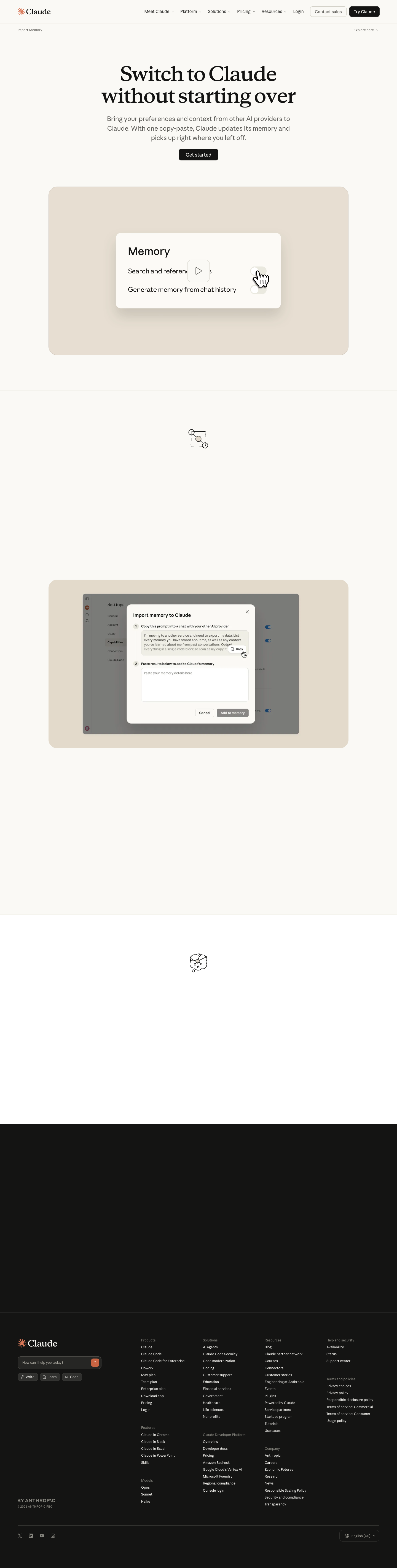
claude.ai/import-memory page
claude.ai/import-memory Β· Captured 2026-03-04 Β· 1440px
Model
qwen2.5:14b via Ollama
Local model, zero API cost. Direct API calls (not subagents) for speed and reliability. All 3 variants tested on identical 20 personas for clean comparability.
Persona Construction
4 types Γ— 5 personas
Built from QuitGPT movement patterns and observed switching behaviors. Held constant across all variants. Not randomized β€” same 20 personas see all 3 treatments.
Success Criteria
3-part test
(a) correctly understands what Claude imports, (b) understands the two-step process, AND (c) personal value is clear. All three required for pass.
Statistics
95% Wilson score CIs
Wilson intervals throughout β€” correct for small N. Per-persona CIs are directional only at N=5. Overall results at N=20 per variant are actionable for ship decisions.